






Your Website Isn't a One-Time Purchase
When you open your jewelry store in the morning, you don't simply unlock the door and assume the store will take care of itself.
Displays change. New collections arrive. Holiday merchandise takes center stage. Lighting gets replaced. Signs are updated. Repairs are made. Your staff learns about new products and new ways customers prefer to shop.
Your website deserves the same attention.
One of the most common misconceptions about business websites is that they are finished once they are designed and launched. A retailer invests in a new website, pays for hosting, and expects that investment to continue producing results year after year.
But a website is not a piece of jewelry placed in a safe, becoming more valuable simply because time has passed.
It is closer to your digital showroom — and showrooms need attention.
Your Customers Keep Moving — Even When Your Website Doesn't
Today, a potential customer may encounter your jewelry store long before walking through your door.
They might search for an engagement ring, look up your store on a phone, read reviews, visit your website, browse social media, compare several jewelers, and return to your website before deciding where to visit.
Recent U.S. consumer research illustrates just how normal this behavior has become. BrightLocal reported in 2026 that 84% of surveyed consumers had searched online for a local business within the previous three months. In their most recent local search, 73% started on a mobile device, and 75% used more than one channel during the process.
For an independent jeweler, that means your storefront is no longer only the one on Main Street.
Your digital presence is another entrance to your business.
And customers notice when that entrance has been neglected.
A website displaying an old promotion, outdated store hours, discontinued merchandise or years-old imagery can unintentionally raise questions. Is the information still accurate? Does the store carry what I am looking for? Is this business active?
Nothing may technically be broken, yet the website may no longer represent the business customers would actually find if they walked through the door.
Website maintenance isn't only about fixing errors. It is also about maintaining relevance, confidence and interest.
Technology Doesn't Stand Still
There is another reason a website cannot simply be launched and forgotten: the web itself keeps changing.
Browsers change. Servers change. Security requirements evolve. Programming languages and databases are updated. Third-party services change their APIs. Search engines change how they crawl and understand websites. New devices and screen sizes appear.
Sometimes those changes are gradual. Occasionally, they are dramatic.
Adobe Flash is a useful example. For years, Flash was widely used to create animations, interactive menus, presentations and entire sections of websites. As web standards and browsers moved forward, Adobe ended support for Flash Player at the end of 2020 and began blocking Flash content from running in January 2021.
A website containing important Flash functionality did not necessarily become obsolete because someone designed it badly.
The world around it changed.
Similar changes continue to happen, although they may be less visible to a store owner. An old script can stop working after a server upgrade. A form that once generated inquiries may begin producing errors. An integration with another service can change. Older code may create security or compatibility problems.
Even search visibility depends on technical health. Search engines need to be able to access, understand and index website pages. A page can still look perfectly normal to a store owner while something behind it has stopped functioning as intended.
That is why ongoing website management includes looking beneath the surface, not simply waiting for a customer to call and say, "Your website isn't working."
Hosting and Website Maintenance Are Not the Same Thing
Hosting gives your website a place to live and keeps it available on the internet.
Hosting does not decide that your Valentine's Day promotion should come down in March.
It does not know that you have introduced a new bridal collection.
It does not replace an outdated photograph, check whether a contact form still works, refresh your homepage for the holiday season or notice that information about your business has changed.
And it certainly cannot decide what will make your customers interested in visiting again.
That requires management.
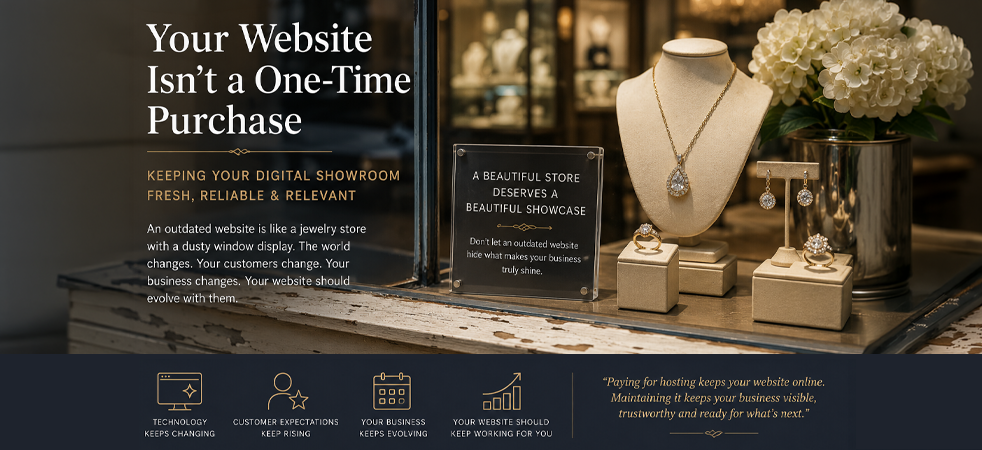
Paying the rent keeps you in the building. It doesn't merchandise the showcases. Hosting works much the same way.
A Healthy Website Should Reflect a Healthy Business
Website maintenance does not mean redesigning your entire site every few months.
Often, small and consistent improvements are far more valuable.
A new banner can introduce a seasonal event. Fresh photography can give customers something new to discover. Updated store information can prevent frustration. New content can answer questions customers are already asking. Technical checks can identify problems before they interfere with inquiries or search visibility.
Over time, larger changes may also become necessary. A website built many years ago may eventually need structural or technological modernization rather than another patch.
The important thing is recognizing that this is normal.
Retail stores evolve. Jewelry styles evolve. Customers evolve. Technology evolves.
Your website should be allowed to evolve too.
Protect the Investment You've Already Made
For many independent jewelers, building a professional website represents a significant investment. Neglecting it after launch does not protect that investment — it gradually reduces what the website can do for the business.
Ongoing maintenance is not about changing things simply for the sake of changing them.
It is about keeping the website useful, trustworthy and relevant to the customers you want to reach today.
Your website does not need to replace the personal service, expertise and relationships that make an independent jewelry store special.
It should help introduce customers to those qualities.
It should give someone who discovers your business after hours a reason to keep exploring.
It should represent the store you operate now, rather than the store you operated five years ago.
And it should remain technically capable of doing the job you built it to do.
Your physical storefront receives attention because you know customers are looking at it.
Your digital storefront deserves the same care.
Is Your Jewelry Website Still Working for Your Business?
A website should grow with your store, your customers and the technology around it.
Planetscape helps independent jewelers maintain and manage their websites — from content and seasonal updates to technical maintenance, integrations and ongoing improvements.
If your website hasn't received much attention lately, it may be time to take another look.