






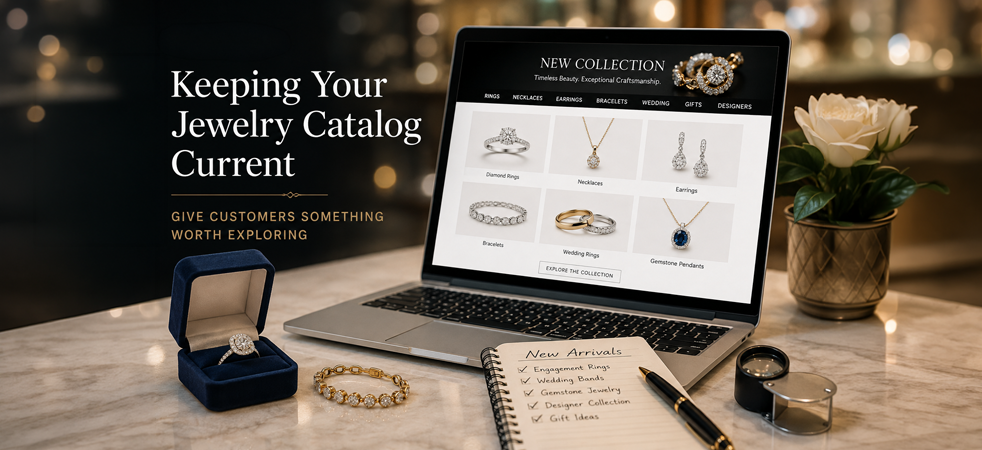

Your Jewelry Is the Reason Customers Came
Imagine walking into a jewelry store with beautiful showcases, good lighting and an experienced staff — but only ten pieces of jewelry are on display.
You might admire those ten pieces. But if none of them matches what you came looking for, how long would you stay?
The same question applies to a jewelry website.
A polished homepage, an About page, store hours and a contact form are important. They establish that your business exists and give customers a way to reach you. But if the website shows only a handful of products, it may function more like a digital business card than a digital jewelry showroom.
And jewelry is a category people want to explore.
Customers compare styles. They look at shapes, metals, designers and collections. They save ideas, send links to partners and family members, return to pieces they liked, and often do that research before they ever enter a store.
Being online is not the same as being useful online.
The Website Can Participate in a Sale Without Completing It
Independent jewelers sometimes assume that a substantial online catalog only matters if they plan to sell jewelry through e-commerce.
It doesn't.
A customer might discover an engagement ring on your website at 10:30 at night. She sends the link to her partner. They look at several styles together. Two days later, they visit your store to see the ring in person, ask questions and work with your staff.
The transaction happened in the store — but the website participated in the sale.
Industry research has shown how important that research stage can be. A Plumb Club consumer study reported by JCK found that about 70% of consumers researched a jewelry purchase online before buying, while more important purchases were still more likely to be completed in-store.
That combination is especially important for independent jewelers. Your website does not have to replace the personal experience of buying jewelry. It can help customers arrive at that experience with greater interest, better questions and specific pieces already in mind.
Give Customers Enough to Discover
A few beautiful photographs can create an impression. A well-organized catalog creates a reason to keep browsing.
Bridal customers may want to explore engagement ring styles, diamond shapes and wedding bands. A gift shopper may be looking for earrings, bracelets or pendants. Another customer may already know the designer or collection they want.
The more clearly your website reflects what your store can offer, the easier it becomes for a customer to imagine buying from you.
This does not mean every independent jeweler needs thousands of products online. It means the website should provide enough depth to represent the business honestly and create interest.
For some stores, that may mean carefully curated collections. For others, supplier or product catalog integrations can provide a much broader selection without requiring staff to manually build every product page from scratch.
The right approach depends on the store. The principle is the same: customers need something worth exploring.
Current Product Information Helps Customers — and Search Engines
A useful catalog is not simply large. It is current.
Product names, images, descriptions, availability and other details should accurately represent what customers can expect. When collections change, designers are added, styles are discontinued or new merchandise becomes important to your business, your digital showroom should evolve with them.
Accurate product information also gives search engines more to understand.
Google supports product information such as product names, images, descriptions, prices and availability through product pages and structured data. Depending on the type of website and product page, this information can help products become eligible for richer appearances across Google Search and Google Images.
That does not mean adding products automatically guarantees rankings or sales. It means a website with meaningful, well-structured product information gives search systems substantially more context than a site containing only a few general photographs.
Your catalog serves people first. But clear product information can also help the systems people use to discover products understand what your store offers.
An Outdated Catalog Can Work Against You
More products are not always better if the information is no longer reliable.
A customer who repeatedly clicks on jewelry that is no longer available may become frustrated. A collection that disappeared from your showcases years ago should not dominate your website. Old promotional pricing, discontinued designers or poor-quality legacy images can make the digital experience feel disconnected from the store itself.
This is why catalog management is an ongoing job rather than a one-time upload.
New arrivals should have opportunities to be seen. Important collections should be easy to find. Seasonal merchandise can move forward when it matters. Older or unavailable products may need to be removed, redirected, marked appropriately or replaced.
The goal is not constant change for its own sake. The goal is alignment between the business customers see online and the business they experience in person.
A Digital Showroom Should Create Curiosity
The strongest independent jewelry stores offer something a large marketplace cannot easily reproduce: expertise, relationships, trust, local reputation and personal service.
A product catalog should not compete with those strengths. It should lead customers toward them.
A beautiful ring online can become a reason to schedule an appointment. A collection page can introduce a designer the customer had never considered. A bracelet discovered after store hours can become tomorrow's phone call. A product link can be shared with someone shopping for an anniversary gift.
Your website is open when your showcases are dark and your staff has gone home.
Give customers enough to make that visit worthwhile.
Is Your Online Jewelry Selection Telling the Whole Story?
You do not necessarily need full e-commerce to build a useful jewelry catalog. You do need a digital presence that gives customers a meaningful view of what makes your store worth visiting.
Planetscape helps independent jewelers build and manage product catalogs, integrate available jewelry data sources, organize collections and keep their online presence connected to the business behind it.
If your website currently shows only a small part of what your store has to offer, there may be an opportunity to give customers much more to discover.