







SEO, AEO and Why Website Structure Matters More Than Ever
The way people search online is changing.
For years, search engine optimization focused primarily on helping websites appear in traditional search results. Today, customers are also using AI-powered search experiences and conversational tools to ask complete questions, compare options and discover businesses.
We begin by assessing your current customer touchpoints, identifying areas for improvement, and using insights to develop strategies that meet your customers’ evolving needs—from optimizing digital platforms to strengthening support workflows.
SEO and AEO Work Together
Search Engine Optimization (SEO) remains an essential part of online visibility. It helps search engines discover, understand and index website content so relevant pages can appear in search results.
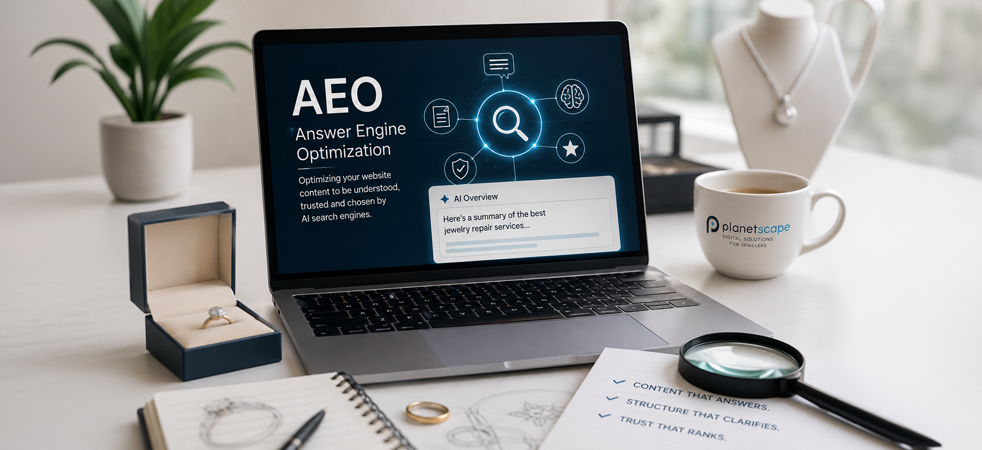
Answer Engine Optimization (AEO) builds on many of those same principles. Its goal is to make content easier for AI-powered search and answer systems to understand and use when responding to a user's question.
AEO should not be viewed as a replacement for SEO.
Clear page structure, descriptive headings, relevant content, internal links and well-organized navigation are valuable for traditional search, AI-powered discovery and, most importantly, the people visiting your website.
AEO doesn't replace SEO. It builds on the same foundation: clear structure, useful content, and pages that make it easy to understand what your business offers.
Can Search Engines Clearly Understand What Your Store Offers?
Consider a jewelry store that provides:
- Jewelry Repair
- Custom Jewelry Design
- Jewelry Appraisals
- Watch Repair
- Engraving
That may tell a visitor that the services exist, but it gives each individual service very little room to be explained in depth.
If Jewelry Repair is an important part of your business, for example, a dedicated Jewelry Repair page creates a much clearer destination for customers looking specifically for that service.
The same principle can apply to Custom Design, Appraisals and other important services.
Why Dedicated Service Pages Matter
A dedicated service page gives each important area of your business its own identity within the website.
Instead of one page attempting to represent everything your store does, an individual service can have its own:
- Unique URL
- Page title and meta description
- H1 and supporting headings
- Relevant written content
- Images
- Internal links
- Frequently asked questions, when appropriate
- Calls to action
A customer searching for jewelry repair does not necessarily want to read through a general description of every service your store offers. A dedicated page allows you to answer questions specifically related to repair and guide that customer toward the next step.
Likewise, someone interested in custom jewelry design may need entirely different information about consultations, design options, gemstones, redesigning existing jewelry or the custom-design process.
Those are two different customer needs. Your website structure should be able to reflect that.
Your Navigation Matters Too
Creating dedicated pages is only part of the equation. Visitors also need to be able to find them.
Navigation helps establish the hierarchy of a website. It tells visitors what information is important and gives them clear paths to reach it.
If major revenue-generating services are buried several levels deep in the website — or accessible only through a general page — it may be worth reviewing whether the navigation still reflects the priorities of the business.
This does not mean every service needs to occupy valuable space in the main navigation. Website navigation should remain clear and manageable.
But important services should have logical, prominent paths from the site's primary navigation and other relevant pages.
Keep the Main Services Page
Creating individual service pages does not mean eliminating the main Services page.
A well-designed Services page can act as a central overview.
For example:
Services
- → Jewelry Repair
→ Custom Jewelry Design
→ Jewelry Appraisals
→ Watch Repair
→ Engraving
This creates a logical content hierarchy and gives visitors the choice between browsing an overview or going directly to the service that interests them.
It also creates opportunities for meaningful internal links between related content.
Helpful Content Still Comes First
There is a temptation whenever search technology changes to start writing content primarily for the technology.
That is the wrong priority.
A page should exist because it provides something useful to a potential customer.
For a Jewelry Repair page, customers may want to know what types of repairs the store handles, whether an appointment is necessary, how the process works or how to request additional information.
For a Custom Design page, they may want to understand how the process begins, whether existing stones can be incorporated into a new piece, or what happens during a consultation.
For an Appraisal page, they may need to know what an appraisal involves and how to schedule one.
Useful, specific information gives customers a reason to stay on the page — while also giving search and AI systems clearer context about what the page represents.
More content is not automatically better content.
Clear, relevant and useful content is the goal.
The Same Principles Apply Beyond Services
Website structure matters throughout a jewelry website. Depending on the retailer, important sections might include:
- Engagement Rings
- Wedding Bands
- Diamonds
- Lab-Grown Diamonds
- Fine Jewelry
- Colored Gemstones
- Designer Collections
- Jewelry Education
- Repair and Other Services
The objective is not to create pages simply for the sake of having more pages. The objective is to make the major products, services and areas of expertise of the business easy to identify and understand.
A website should reflect what the store actually wants to be found for.
Internal Linking Helps Create Context
Internal links connect related pages within your website.
A Services page can link to Jewelry Repair. A Jewelry Repair page can link to Contact Us or Request an Appointment. An educational article about diamond shapes can direct a visitor toward relevant engagement-ring collections.
These connections are useful to customers because they make the website easier to navigate.
They also create relationships between content.
Instead of a collection of isolated pages, the website becomes an organized network of information in which related topics naturally connect to one another.
Frequently Asked Questions Can Add Useful Context
Internal links connect related pages within your website.
Frequently asked questions can be valuable when they address questions customers genuinely ask.
A Custom Design page might answer questions about using an existing diamond. A Jewelry Repair page might explain whether the store repairs jewelry purchased elsewhere. An Appraisal page might explain what customers should bring to an appointment.
FAQs should not be added simply because AI search exists.
They should be used when concise questions and answers genuinely improve the page and help customers understand the service.
When they do, they also provide clear, structured information that search and answer systems can interpret.
What About an Older Jewelry Website?
Internal links connect related pages within your website.
Many jewelry websites currently in use were designed several years ago.
That does not automatically mean they need to be replaced.
A website can still look attractive and function well while its underlying content structure no longer reflects the way customers search today.
In some cases, the right solution may be a complete redesign. In others, practical updates to the existing website may be enough.
Those updates might include:
- Reviewing the main navigation
- Creating dedicated pages for important services
- Reorganizing existing content
- Improving page titles and headings
- Updating metadata
- Strengthening internal links
- Adding useful FAQs
- Updating outdated content
- Making important information easier to reach
Sometimes the better question is, "Does our current website still represent our business effectively?"
Your Website Should Evolve With Your Business
Jewelry stores change over time.
A store may add custom design, introduce lab-grown diamonds, expand its repair department, add designers, begin offering appointments or shift its focus toward different product categories.
The website should evolve with those changes.
A service that was relatively unimportant when the website was first built may now represent a significant part of the business. A product category that once deserved prominent navigation may no longer be a priority.
Website structure should not be frozen at the moment the site launches.
Regularly reviewing navigation, content and page organization helps ensure the website continues to reflect the business behind it.
Preparing for the Future of Search
No website company can guarantee that a business will appear in a particular AI-generated answer, just as no responsible SEO provider can guarantee a specific organic ranking.
Search technology will continue to evolve.
What businesses can do is build a stronger foundation.
A clearly organized website with useful content, dedicated pages for important topics, logical navigation and meaningful internal links is easier for customers to use and easier for search technologies to understand.
Preparing for AI search is therefore not about chasing every new technology or abandoning traditional SEO.
It is about making your website clearer, more useful and better organized for the way people are searching today — while creating a structure that can continue to evolve tomorrow.
Is It Time to Review Your Website Structure?
If your jewelry website was built several years ago, its navigation and content structure may no longer reflect current search technology — or even everything your business offers today.
Planetscape can review your existing website structure, navigation and service content and recommend practical updates to help strengthen its organization and prepare it for today's evolving search environment.